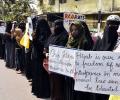
India and Indians can ignore Pakistan, but that cannot be said of other nations in the neighbourhood, where New Delhi's 'Neighbourhood First' policy constantly reverberates. Four of the eight SAARC member-nations are Muslim -- Afghanistan and Pakistan, Bangladesh and the Maldives. The rulers decide the nation's India or anti-India policy in the first two, and street-opinion contributes to the same in the latter two, points out N Sathiya Moorthy.

Prime Minister Narendra Modi's visit to Arunachal Pradesh on Friday, February 20, irritated the Chinese government so much that it summoned the Indian ambassador to register its protest against Modi visiting a territory China claims as Southern Tibet.

Do Modi's foreign visits actually serve India or they nothing more than expensive tools for domestic positioning and image-building, asks Shehzad Poonawalla.
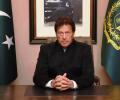
India cannot afford to be complacent about a possible Pakistan resort to military options across the LoC, warns Rana Banerji, who headed the Pakistan desk at the Research and Analysis Wing, India's external intelligence agency.
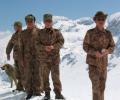
'The border standoff, if not properly addressed by both sides, could escalate to a conventional or sub-conventional conflict between India and China,' predicts Srikanth Kondapalli, one of India's leading China experts.

'It is certainly time for New Delhi to open up. Not only should it go ahead at full steam with the roads to the LAC, but the government must also allow tourists to visit these stunningly beautiful areas of Indian territory.'

'Without doubt, General Bajwa has deliberately snubbed India.' 'But why did he do that?' 'The Male leadership is simply fed up with Indian interference,' says Ambassador M K Bhadrakumar.
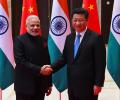
It would be a chance lost if India cannot learn from and lean more on China to kick-start trade, infrastructure programmes, and increased ties, says Ravi Agrawal

'India's military posture has become significantly stronger than China's on the 3,500-kilometre Line of Actual Control.' 'This is enhancing confrontation between the two sides,' points out Ajai Shukla.
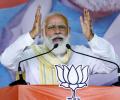
Modi also berated the Rashtriya Janata Dal-Congress combine in Bihar, calling it an alliance of "double-double yuvraj" (two crown princes) whose sole concern was to protect their "respective thrones".

'China's latest defence White Paper has been issued against the backdrop of the upgraded Sino-Pakistan strategic relationship which has impinged on India's sovereignty and territorial integrity, and Beijing's continuing intransigence on tackling the issue of the disputed border or intrusion by PLA troops,' says Jayadeva Ranade.
'India needs to learn in Kashmir how to spread development.' 'Pakistan needs to learn in Balochistan how to spread development.' 'China needs to learn in Xinjiang and Tibet.' 'And if they can show tangible benefits, there will be less terrorism.' 'No one wakes up in the morning saying 'I want to kill myself', right?'

'The intrusion in Chumar, during and beyond the Chinese president's visit, is unprecedented and has qualitatively changed the tone of the India-China relationship,' says Jayadeva Ranade, a member of the National Security Advisory Board.
Prime Minister Narendra Modi's initial weeks in office and the composition of his national security team give a sense of his government's foreign policy and national security priorities, says Harsh V Pant
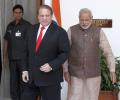
'Instead of isolation, India should respond militarily to every act of terrorism assessed to have come from across the border, unilaterally declare Pakistan a State that supports terrorism and cease all economic dealings with it.'

The former prime minister also criticised the current government for 'messing up' the economy.

'China's growing nexus with Pakistan and the two countries' unresolved territorial disputes with India continue to pose a formidable national security threat to India,' says Brigadier Gurmeet Kanwal (retd).

Major General Sujan Singh Uban, a legendary veteran of the Second World War, was a natural choice to raise, train and command the Special Frontier Force and mould them into a well oiled fighting machine, recalls his son Inspector General Gurdip Singh Uban (retd), who led SFF troops during the Kargil War.
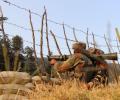
'India has to understand that the permanent state of war that exists between India and Pakistan has to be expected,,' says Colonel Anil A Athale (retd). 'The only way to ensure peace or absence of war is to maintain a militarily-dominant position over Pakistan.'

'The military aim in a future conflict, if it can't be avoided, should be to cause maximum damage to the adversary's war waging capability and capture limited amount of territory as a bargaining counter,' says Brigadier Gurmeet Kanwal (retd).

One thing Beijing must understand is that India is not obsessed with being a threat to China but only wants a rightful place for itself in the world, says Sanjeev Nayyar.

'Vijay Gokhale's appointment as foreign secretary can be regarded as a certain 'adjustment' that could make a difference to the poor climate of India-China relations,' says Ambassdor M K Bhadrakumar.

When China protested strongly over the August decision on J&K -- not once but twice -- we ignored it. And to compound matters, we simply turned our back and walked over to the 'Quad' alliance with the US, upgrading it to ministerial level, and thereafter began following the American footfalls on Taiwan and COVID-19 to taunt and humiliate Beijing, observes Ambassador M K Bhadrakumar.

Indians at large harbour a notion that their country is cherrypicking out of the American basket of goodies, but the policymakers in Delhi and the political leadership are well aware that it can only be a pipe dream since a military alliance with a superpower is a profound irrevocable commitment, observes Ambassador M K Bhadrakumar.

In this series, Rediff.com presents a selection of the year's most enduring moments year from around the world.
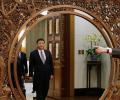
China's white paper on Asia-Pacific security cooperation extends an olive branch to India. It mentions India 15 times -- a record in all Chinese white papers issued so far. New Delhi's response will need to be carefully calibrated, says China expert Srikanth Kondapalli.
'It is a pattern of behaviour of the Chinese that whenever a Chinese leader visits India or an Indian leader visits China, some incidents take place.' 'When Modi visits China, we should look out for some similar demonstration by the Chinese.'

The decision to not attend the forum attended by 28 heads of state and 130 national delegations is a clear break from its usual policy of going along with the crowd.

China sees India and Japan's 'North East Road Network Connectivity Improvement Project' as a challenge to its OBOR, says Rajaram Panda.
The second and final part of former cabinet secretary Naresh Chandra's interview to Sheela Bhatt.

Those who know Shiv Shankar Menon will vouch that he did lots of things, substantial in the immediate neighbourhood and widespread in South Asia, but without making things public. Twenty per cent of Menon's job was visible, while 80 per cemt of his job was not known to the public, says Sheela Bhatt/Rediff.com

'While visits and personal meetings are useful, changes of strategic significance have occurred recently, with Beijing trying to take the lead which Modi must take note of.'

Not many people in Bangladesh are talking about the Teesta issue.
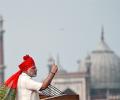
'Independence Day has been India's annual general meeting. For the most part, it has been a forgettable experience of ritual observances. Not so this year... Mr Modi instead presented what I call a moral balance sheet of India,' says Shreekant Sambrani.

'For a long time Pakistan dreamt that India would break up and that it would be the predominant power in the region,' says Colonel Anil A Athale (retd).
'Ensuring through diplomatic means and in conjunction with strategic partners that India will not be required to fight a simultaneous two-front war with China and Pakistan.' Brigadier Gurmeet Kanwal (retd) lists what India must have in its national security strategy.
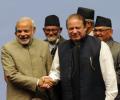
'Modi has said he has been made the PM of India not to do small things but big things. What bigger thing can there be than to have peace with Pakistan and in the neighbourhood?'

The expulsion is likely to cloud India-China ties as Narendra Modi visits China for the G-20 Leaders Summit on September 4-5 and Xi Jinping is scheduled to be in Goa for the BRICS meeting on October 15-16.

'Crafting a coherent, transparent and consistent policy vis-a-vis our neighbours, leave alone the rest of the world, is unlikely to be high on the priority list of the new Indian government, which will be sworn in before June,' says Ramananda Sengupta.

'If, as appears to be the case, India is on way to 'mending fences' with China, and China is equally desirous to 'reset' the relationship, this could be a self-reflexive moment in India's positioning vis-a-vis not just the Dalai Lama, but also the Tibetan issue and China as a whole,' points out China expert Alka Acharya.
